

When Meghan came to coaching, her wealth management firm was growing significantly.
Over the previous four years, she had acquired two additional books of business and increased revenue by 30 percent. She intended to grow the firm threefold over the next five years, both via acquisition and organic growth
As the firm expanded, the demands of leadership increased:
- More complex decisions required her judgment
- Team members escalated questions to her by default
- Strategic thinking competed with execution demands
The business was performing, yet the leadership model that had built it depended heavily on her personal involvement, creating a ceiling on how efficiently the firm could scale.
Why Coaching Now
Meghan recognized that the way she was operating would not sustain the level of growth she was pursuing. She was holding decisions too long, revisiting them and carrying responsibility that could be distributed more effectively. Over time, this began to erode her energy and clarity.
She wanted structured space to strengthen how she led under pressure and clarify her role as the leader of a scaling firm.
She also wanted a coach who understood growth from direct experience and could integrate leadership development with practical operating insight. She chose to work with me because I have led through growth-phase professionalization firsthand and help leaders build leadership capacity to support scale.
The Engagement Focus
Meghan selected a four-month engagement with bi-weekly sessions.
Our focus was to separate productivity from self-worth, strengthen her ability to regulate under pressure and clarify both her long-term business vision and her executive role within it.
The Leadership Shift
As we worked together, Meghan’s leadership became more deliberate and less urgency-driven.
Key shifts included:
- Personal values and leadership identity: She defined her personal values and clarified how they guide her decisions, leading from who she is rather than modeling her leadership on examples she had observed elsewhere.
- Prioritization: She became more disciplined about where her attention created real leverage, accepting constraints that could not be changed and redirecting energy toward decisions and priorities that moved the business forward.
- Effective decision-making: She increased decision velocity by assessing risk directly and applying an ROI-based lens, reducing second-guessing and shortening the cycle from decision to action.
- Strengths-based delegation: She clarified her strengths as an executive and identified where capability needed to be supplemented within her team or through new hires. She delegated responsibilities with clearer expectations and accountability.
- Leadership confidence: She handled direct report needs and high-stakes client conversations with greater composure.
Through the process, she saw herself more clearly as the owner and executive of the firm. Her leadership capacity expanded to match the complexity of the business she is building.
The Business Impact
As Meghan’s leadership model evolved, the business began to move more cleanly.
- Increased execution pace: She reduced her role as the default decision-maker and enabled the team to move priorities forward with clearer expectations and stronger delegation
- Clear strategic direction: She dedicated focused time to document the business growth strategy in a strategic plan
- Role clarity and hiring: She clarified the roles required to supplement her strengths and began hiring to fill those gaps
The growth strategy did not need to change. The leadership model did. By evolving how she led and how the team was structured around her strengths, the firm positioned itself to scale without increasing dependence on her.
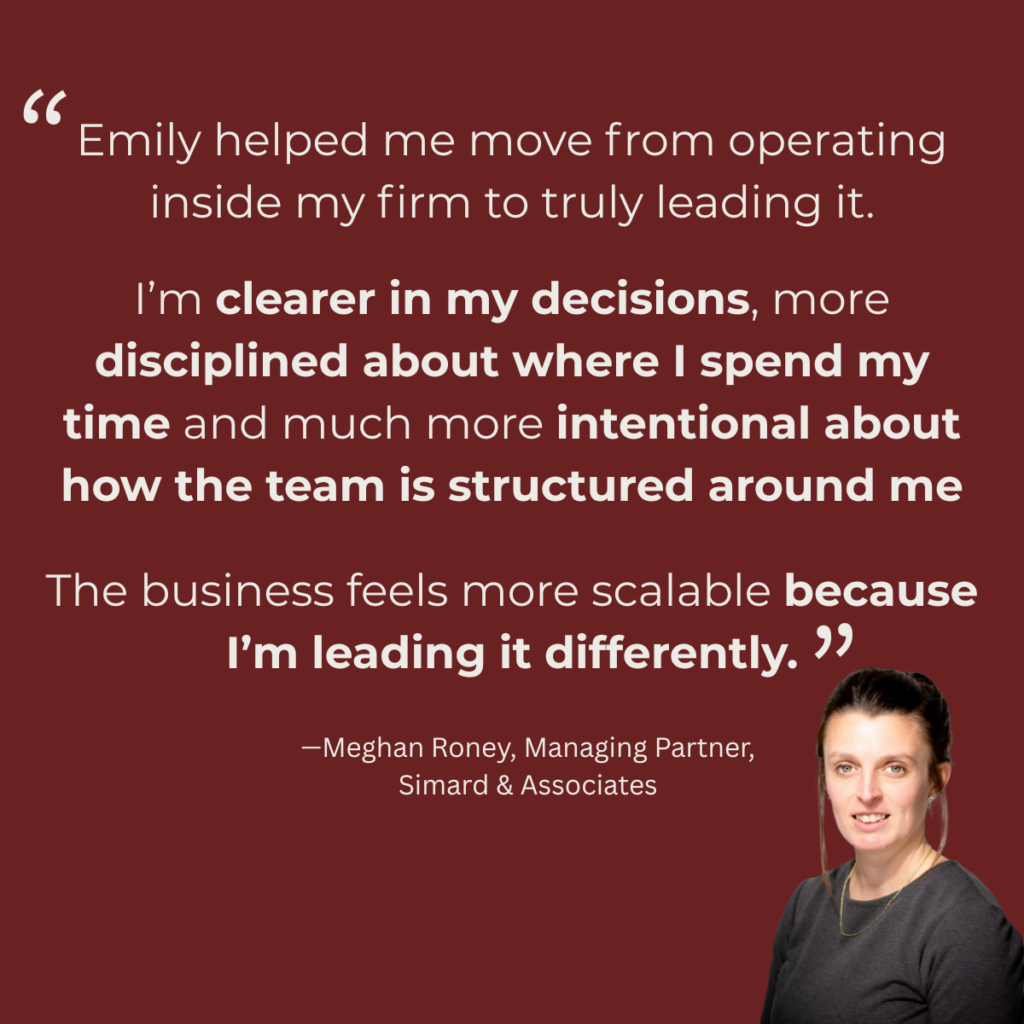
Meghan entered coaching with strong momentum and an ambitious growth target.
She left with a leadership model capable of supporting that growth through clearer decisions, stronger delegation and faster execution.
Let’s explore what leadership capacity at scale could look like in your growing business.
Book a free 20-minute coaching discovery call here.


