

Jessica was stepping into her first Director role during a period of accelerated growth and structural change.
Three regional organizations had been consolidated, tripling overall size and requiring a full restructuring. A new President and CEO had also been appointed and several C-suite roles had shifted.
Jessica moved into a role that carried budget ownership, diverse stakeholder management and strategic direction over a newly created initiative. She was working directly with senior leadership for the first time and was responsible for defining a program that required clear outcomes and measurable impact.
At the same time, her new manager was preparing to take a year-long leave, which meant Jessica would be operating with significant autonomy early in her tenure.
Why Executive Coaching Now
Jessica understood that the leadership approach that had made her successful previously would not automatically scale to this level of responsibility.
The organization had created a scholarship program to invest in emerging leaders during this phase of growth. Jessica chose to use coaching as a way to intentionally strengthen her leadership skills and prepare to operate independently during her manager’s absence.
She selected me as her coach because I have led through major growth and organizational consolidation firsthand. I understand the operational realities of integration and the leadership expansion required to translate vision into execution during change.
The Engagement Focus
Jessica engaged in two four-month coaching engagements with bi-weekly sessions.
Our work focused on defining a long-term vision for her new program and translating that vision into outcome-driven goals that could be approved before her manager’s leave. At the same time, we strengthened her executive presence and clarified her leadership identity so she could make decisions confidently and operate with greater independence.
The Leadership Shift
Over the course of our work, Jessica’s leadership became more grounded and deliberate.
Key shifts included:
- Expanded capacity to hold complexity: She became more disciplined about filtering noise and identifying what truly required her attention in a fast-moving environment.
- Improved decision quality under pressure: She increased decision velocity by trusting her judgment and moving forward without waiting for complete certainty.
- Stronger executive presence: She developed a clear point of view in senior leadership discussions and contributed with authority, including challenging thinking when needed.
- Defined leadership identity: She clarified a leadership style rooted in direct communication, values alignment and thoughtful challenge.
- Autonomous leadership: She strengthened her ability to lead her program independently during her manager’s absence.
Her leadership capacity expanded to match the scope of the organization she was serving.
The Business Impact
As Jessica’s leadership matured, her department moved forward with greater clarity and faster execution.
- Clear program direction: She established a defined plan with measurable objectives, enabling focused execution.
- Independent program management: She now leads her portfolio and liaises directly with senior leadership without requiring close oversight.
- Higher quality contribution: Her perspective deepens executive discussions and strengthens collective decision-making. She has become a “go to” thought partner for leaders throughout the organization.
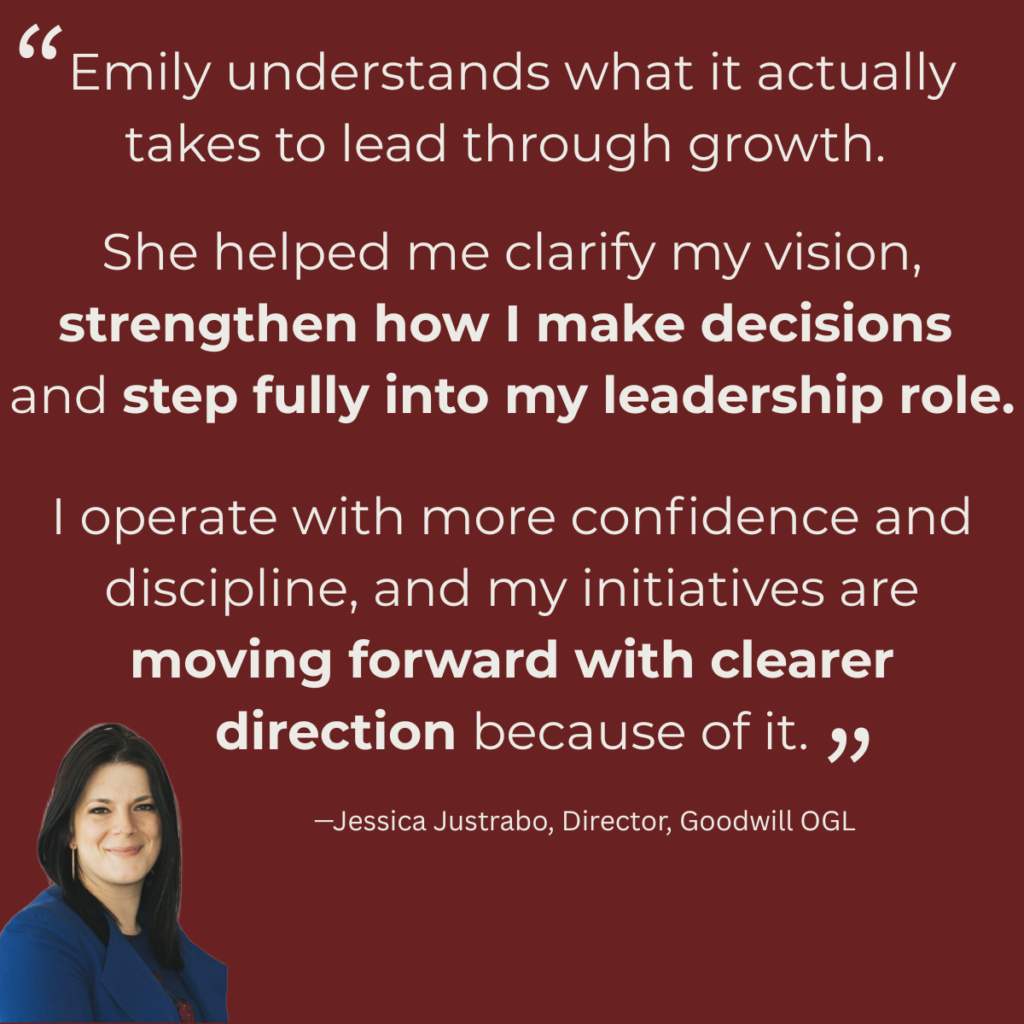
Jessica entered coaching during a period of organizational transformation. As scope and complexity increased, she expanded her leadership capacity to operate with clarity and autonomy.
By investing in Jessica’s leadership capacity during a moment of scale and transition, the organization supported continuity, protected momentum and strengthened its next layer of leadership.
If your organzation is experiencing rapid growth or organizational change, let’s explore what expanding leadership capacity could look like for you and your team.
Book a free 20-minute coaching discovery call here.


